

 Dec 18, 2025
 3 min read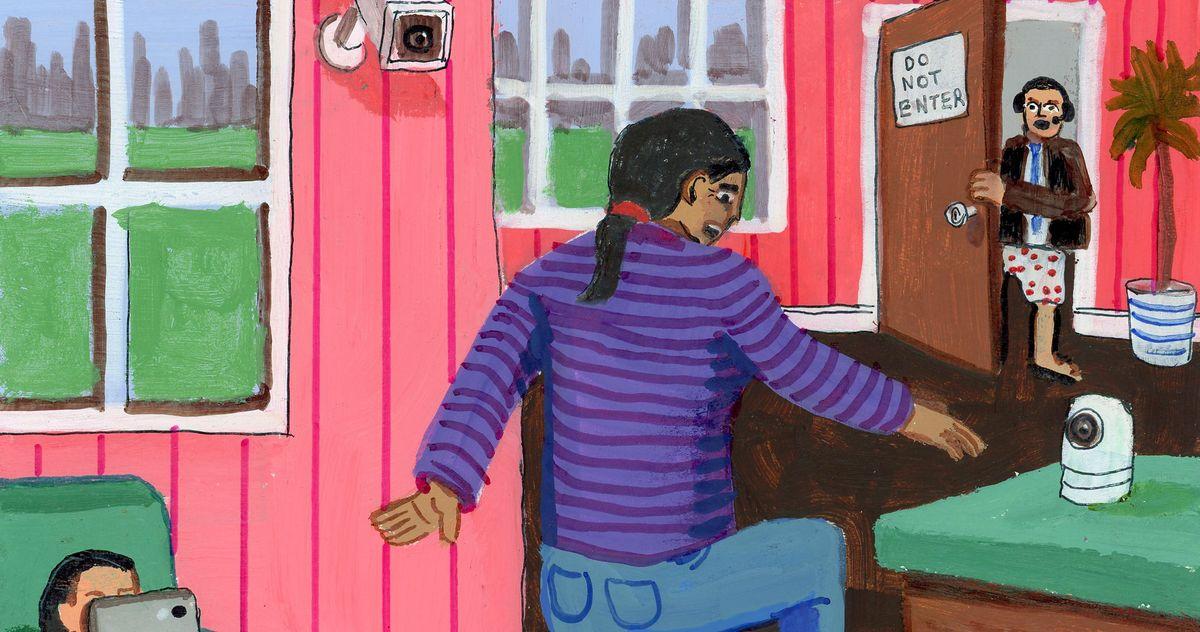
New York City's family with the true parents, but it doesn't care; it is more secure; it is very important to the new generation to serve by humans.
This fall, a shocking story unfolded in New York City's vibrant childcare community.The source of the information was a November post on Nannies of New York City, a popular Facebook group.An experienced nanny we'll call Julia writes that she was recently hired full-time by an Upper West Side family.Father works from home - not ideal for most childcare workers but manageable.Flags.On Julia's first day, she learned that her parents expected her to stay indoors with their baby all day.It's not fair, but every parent has their quirks and work is work.Julia then began to join the father while doing crafts or puzzles with the baby and even hovering over a diaper change.Sometimes she and the little boy were "doing nothing and laughing happily," and Dad would come into the room and suggest that she study the ABCs.
Now this was unbearable.They had to start leaving the house.But when Julia suggested outings such as trips to museums or games, she was refused, saying that the little one might be sick.Finally, a few days after her new job, she was allowed to take the baby to the park with a strict limit of 90 minutes.She had arrived at work that morning a few hours earlier and hadn't eaten since then, she was going to the park.Along the way, she enters a shop with the baby to have a snack.She knows that parents track her through AirTags on strollers—a practice that was once dystopian, now commonplace and unremarkable—but she doesn't expect how much they will track her movements.As she enters the store, Julia receives a frantic call from her mother.She was fired that day.
Some Facebook members with about 26,000 members were outraged and advised Julia to take legal action.Some urged him to make his parents' real names public so that others would not suffer the same fate.Others are not interested.The group, founded about nine years ago by Brooklyn resident and nanny Michelle Wresman, was designed as a resource for employees without HR channels.Since then, social workers have used the organization to raise wages., asked for advice on the type of contract and CPR training.But in recent years, the babysitters are rising around the parenting behavior that can be classified as different, right, hostile and fearful.The parents Julia describes are a very popular type: millennials whose children's intelligence, emotional well-being, and immune system have been shaped by millennials, who have thrown the babysitter into a bag for their high interest and expectations."It was a good escape!" They did you a great favor!"one commenter replied to Julia.
Being a working person is often in a state of depression, you consider the unreasonable demands of your boss or your clients and turn your business progress into chaos or oblivion.But it seems there's never been a worse time to be a goat in New York City.As children from COVID-19 head off to preschool and kindergarten, a critical mass of city parents are looking for work for the first time in years and find a radically changed environment.Almost every part of life has new expectations.Child's: nutrition, sleep, education, mental development, screen time.A new generation of parents is worried and uncertain but also wants to control everything - a cruel combination.There have always been difficult families, especially among the wealthy, and for a long time nannies and parents had to negotiate to find a suitable middle ground.But now, parents are at once insecure and full of child-rearing ambition and pop psychology—after years of consuming parenting content on the Internet—as many child managers as seasoned professionals are automatons tasked with raising their children.
Everyone knows that an insecure boss is the worst kind.But what's worse, many of these bosses are scared - parents now work from home, giving them the ability to watch their children's every move.At the same time as many of the nannies I've spoken to, these parents, who are facing the same rising costs of living as others, often don't want to pay for the things they're looking for.All that said, the parent-nanny relationship is stressful and unsustainable.Something has to give.
“It used to be an autonomous role,” said Joe Barrow, CEO of Nannies by Nova, a “personalized, high-touch” nanny agency in New York. “Back then you didn't hear about stay-at-home moms or work-from-home parents having nannies.If they went home, they would take care of the kids themselves.” Now, Barrow said, about 85 percent of the families he works with have at least one parent at home.
There are still unicorn dream families - those who pay well, trust their grandmother's judgment, and just want their children to be safe and happy.And strangely demanding parents aren't exactly new;Nannies have always had to deal with employers who seem steps away from the headlines of the New York Post, especially among the über-rich who offer the highest paying jobs in town.Barrow recounted a classic case in point: "We once had a gentleman call us and say he needed a nanny who spoke Hebrew and might be interested in learning to fly his plane. I said, 'I don't know about that.' But we actually found her."
Now, even “normal” parents—middle class and moderately wealthy—have become extremely picky.Many people have become accustomed to outlining expectations in detail in their child care contracts.In an article published this fall for a New York City nanny group, parents said their nannies should focus on "frequent talking and singing to encourage language development, including at meals and diaper changes."detail.“Example: Sing the ABC song during diaper changing/teeth brushing, explain what the nanny is doing (I change your diaper, wipe or pick up food, etc.)” Shocking: These people are screen bullies too.Millennial parents know how easy it is to become addicted to their phones at work, so it makes perfect sense to use them with caution.But these parents wrote that it would be nice if only cell phones were strangers in the big white van.Nanny phones are not allowed at all except in emergencies, and even then they should be used "discreetly and out of sight of children."One imagines a parent watching the nanny intently through a baby monitor or home security camera and receiving an alert that a screen will appear on the screen.
Even laid-back parents have their own neurotic cues to adapt their social media algorithms to any parenting trends.Stephanie, a former New York City nanny who started her own mom-matching agency in upstate New York during the pandemic, recently worked with a couple who were really nice, she said, with one tough exception.granola lacini Instagram Instagram, in which the traditional diaper-to-potty training path must work more seriously.These include babies noticing more subtle cues and then "peeing or pooping" in the toilet, often from the first days of the baby's life.For mothers, this can mean monitoring the eight-week-old baby's cries or changes in body position and then going to the baby to "extract" at the appropriate time.Work with 20 years of experience that implementing pediatric-approved rules for potty training kids between 2 and 3 years old can happen, only to have that knowledge completely disappear as first-time parents watch a few well-crafted Instagram reels.
The uncertainty and perfectionism of these new parents also leads to strict supervision of even the basics of the job.“Many parents get experienced babysitters.And then they manipulate them to the smallest and most extraneous details,” said Joana, a 43-year-old babysitter in Manhattan.“They were like, ‘Hey, can you make sure you grind the food into pieces?’ Like, OK, do you really think I can't handle the basic things that we do every day?'” Things were different a few years ago.Joana adds, “Before, we didn't have a schedule.It's more about following the baby's commands.”
"I always said, 'Never wake a sleeping baby,'" said Karla, a 40-year-old nanny in Brooklyn who has been in the business for about 15 years.But when she took a new job to take care of a baby at the beginning of the year, the parents put pressure on her to wake the baby from his sleep before he wakes up naturally, arguing that he would sleep better at night."This baby is angry all day because he or she is tired," said Karla.When she tried to reason with the parents, she said that they will learn some wisdom from reading a book or passing it on from a friend.They seem preoccupied with the approach of everyone." They come out with, "Oh, well, my friend does this way." "It's not about your friends," said Karla. To see the baby monitor, even when they are at work. When the baby wakes up alone, she rushes, in a few moments, to notify Karla.
Sasha, a toddler and babysitter in Manhattan, discovered that these hypervigilant parents are also often harsher than the parents of the past.Last summer, she quit her job for the first time in her 20-year career as a nanny.What was initially billed as part-time, her hours quickly increased from 60 to 70 hours per week and her mother became increasingly demanding and sophisticated.Meanwhile, Sasha felt a complete lack of respect from her employers."We nannies," she says, "we practically live in your house because we're there ten, 11, 12 hours a day. Your house is like our second home."But my mother, she said, "spoke so rudely to me in front of people that it was embarrassing. I'm an adult, you know?"
He left and got a job with new parents and the atmosphere is more stable.However, he still struggles with power struggles every day.One of the biggest challenges she's faced recently is transitioning into full-time parenting.always."His new users—perhaps influenced by a bland and medicated upbringing—don't share that view. "He seems in control, and he's 2 years old," Sasha said. "He shouldn't be like that." Her mother, overhearing the exchange, came out of her office and handed the baby a bag. She often talks about how kind the parents are and their various branches. These parents manage childcare, "NONE OFTHESE PARENTS DON'T WANT TO FACE THE TRUTH ABOUT THEIR CHILDREN NOT EDUCATING EACH OTHER."
Joanna told me that her experience over the years has made her very selective about the families she works with: Parents who work from home are a deal breaker.One thing, she says, the house is calmer, the babies are happier, when the voice of the government is the same at the same time.She also noted the negative impact on parents who insist on helicopter nannies.Their work suffers.then, you can only look at your son."
"Before COVID, I loved being a nanny," said Louise, a 51-year-old Brooklyn resident who has lived and worked in Brooklyn for 23 years. "When I go in, my parents go out."For a while, she was so independent in her work that she would occasionally say to her friends, "Oh my God, I think my mom forgot she had kids." That all changed in 2021. When Louise was assigned to work with a family whose micromanagement and nervous energy were becoming a burden to her. Her mother, who had cameras installed in the apartment, became increasingly difficult to please. Louise was making $25 an hour, the standard wage for a child, but like many parents struggling with inflation,they also wanted more for less. In New York, the standard minimum rate for two children is $35, which would be higher if they were expected to do housework, but Louise's employer offered her a $1 hourly raise and said the new rate would include laundry for the family.
Adding insult to injury, the mother began refusing to pay Louise for days when she decided to take the child on a family visit.In full-time babysitting programs, parents agree to pay for a guaranteed number of hours per week, month, or year, even if the programs change."But nobody talks orally anymore."Mhara nannies say parents talk down to them and hide behind digital barriers, adding to the sense that they expect babysitting to be seen as a service activity in the gig economy, rather than the private, family activity that has developed over the years.
One child in this family also had behavioral problems.One day when the grandfather came to visit, the child started throwing things on the floor.The grandfather fed up and declared to the mother: "You have created this monster" and left the house.Louise herself became pre-diabetic due to high blood pressure.She felt that her parents' stress and disrespect increased both her health problems and the child's problems."I think I'm afraid of her," Lewis said of his mother.Agree." One day, Louise came to work crying. "Maybe I'll go work in the store," she said. Many nannies don't have the same options. "I think, can I really be a nanny?It's not for me."
Louise was not alone in thinking of an exit.This year, she says, a number of her colleagues have left childcare to pursue new careers, many of them domestic workers.Carla told me that her current family will be her last;when the baby she cares for reaches school age, she plans to return to the interior design job she quit years ago.She believes it has the potential to be less emotionally taxing."The new candidate really needs to be able to read the temperature in the room. You know, mom gets a call, dad has something to do, the kids are crying because they can see their parents in the next room, but they can't get them," she said."There's all this pushing and pulling going on."
The next time Louise's employer left town to visit relatives, she began interviewing other families and considering retail jobs.When her parents returned, she found herself on a short outing with her new family.She entered a new arrangement with fear.But paid her the money her family had previously given her for two dollars.They seem to really respect her.“This family has shown me that there are still good people there,” says Louise.
Deb, a Brooklyn-based nanny who started working in 2004, began planning her escape before things reached their current fever pitch.In 2020, the month of the pandemic, she enrolled in nursing school and began a difficult double life as a full-time nanny and full-time student.She said that in her early days of seeing children, the parents were "very involved and made you feel like they cared about you as an individual."A parent-child relationship has the potential to be a deep, long-lasting friendship.New parents, she notes, "care about what you're doing, but not about you as a person."They're more likely to drop a nanny out of the blue, she said.Deb also wanted more mental stimulation from her work.In her early years, she felt compelled to nanny because of the immigration situation in the city, but now she has filed for permanent residency."I thought my talent was underutilized," she told me.
This fall, she quit her last job and began transitioning to nursing.He was amazed at how simple his new job was.It was cold, and she remembered what it was like to camp out all day with children and other colleagues in the freezing local library - often asked to stay outside while parents worked at home.Now he has health insurance and retirement benefits, both of his own."I tried to tell my friends," he told me, "Man, parenting is changing. You should think about your next move."